
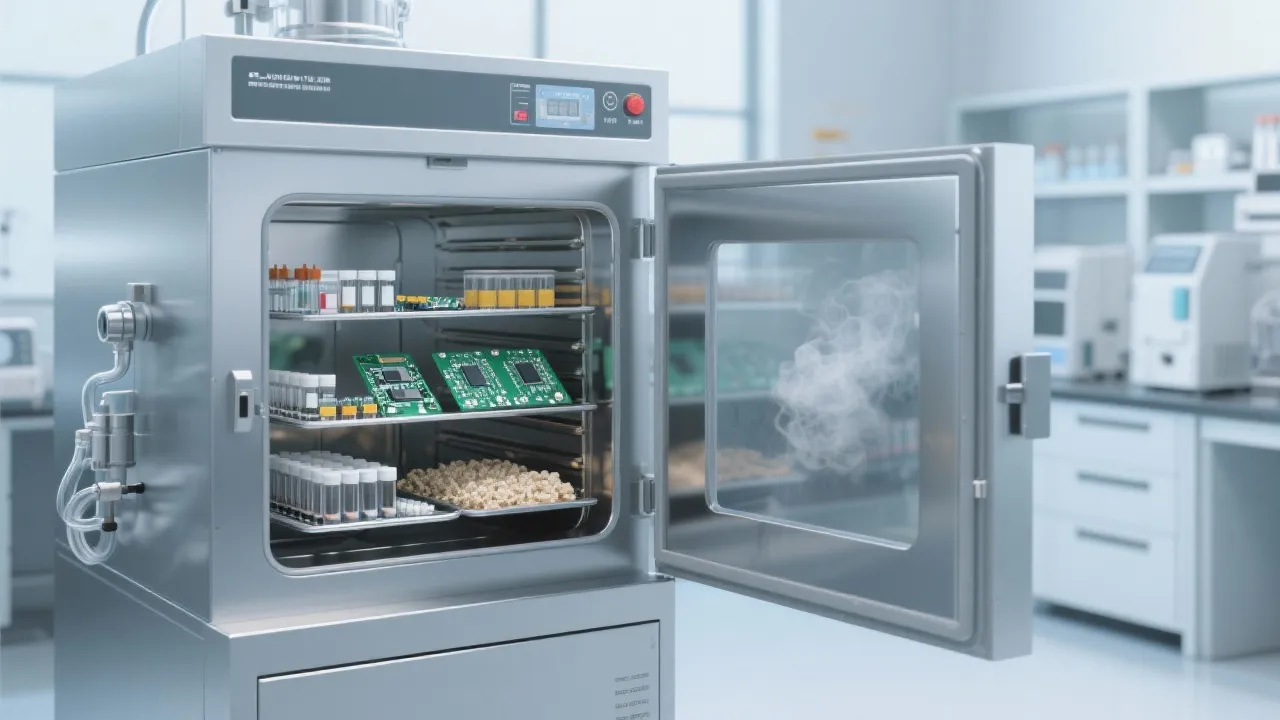
Choosing the right drying oven is a pivotal decision in both scientific research and industrial production environments. As the demands for precision, efficiency, and safety intensify, selecting equipment that aligns with specific experimental or manufacturing needs becomes critical. The DZ-4BCII Digital Vacuum Drying Oven emerges as a sophisticated solution that balances performance and reliability, featuring a spacious 214.5L chamber, precise temperature controls from 10°C to 250°C, and robust vacuum capabilities below 133Pa.
In laboratory and production settings, the drying oven’s capacity is dictated by sample volume, batch processing needs, and available workspace. A 214.5L chamber, as with the DZ-4BCII, effectively accommodates large batches, reducing cycle times and bolstering throughput.
| Capacity (Liters) | Ideal Application | Batch Size |
|---|---|---|
| 50-100 L | Small-scale research | Up to 5 kg |
| 200-250 L | Medium to large research & pilot production | 5-15 kg |
| 300+ L | Industrial scale manufacturing | 15+ kg |
Temperature accuracy and range are fundamental for comprehensive drying processes. The DZ-4BCII offers an extensive 10°C to 250°C range, enabling compatibility with delicate polymers, catalysts, biological samples, and pharmaceuticals. Its four-wall stainless steel heating system ensures rapid and uniform temperature distribution, crucial for consistent drying and material integrity.
Moreover, precise temperature stability ± 1°C permits exact timing and controlled drying cycles, reducing overheating risks and preserving sample quality. For industries requiring strict adherence to ISO 13485 or Good Manufacturing Practice (GMP) standards, such level of control is indispensable.
The vacuum capacity of less than 133 Pa elevates drying efficiency by lowering the boiling point of moisture, thus preserving heat-sensitive compounds and speeding up solvent removal. This capability benefits applications like catalyst drying, microelectronic component preparation, and polymer annealing, where oxygen-free environments prevent oxidation and contamination.
The intelligent control system of DZ-4BCII introduces safety interlocks, programmable presets, and real-time monitoring. This technology simplifies complex drying protocols, reduces operator error, and enhances data traceability—features highly valued in regulated environments.
Consider a pharmaceutical lab drying temperature-sensitive intermediates: ample capacity allows batch processing without compromising cleanliness, while precise temperature and vacuum control maintain compound stability, speeding production timelines.
In polymer research, wide temperature adaptability supports experiments on varied materials, from low-temperature drying of hydrogels to high-temperature cures. The vacuum function further improves polymer morphology by removing residual solvents.
Catalyst manufacturers benefit from uniform heating and vacuum conditions that ensure active site preservation and consistent catalyst performance.


 <#else>